
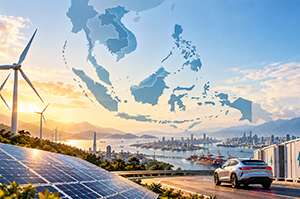
The global energy transition is no longer just a race to build renewable power plants. Alongside the expansion of clean electricity generation capacity, a new competition is emerging to capture different segments of the value chain, from solar equipment and wind turbines to batteries, electric vehicles, raw materials, engineering services, and related technologies.
A recent report by the International Energy Agency (IEA) on energy technology supply chains highlights how Southeast Asia’s energy industry is becoming a clear example of this transformation. The region’s market for key clean energy technologies, valued at approximately $5 billion in 2020, reached around $25 billion in 2025. Under announced policy scenarios, it could exceed $80 billion by 2035. Much of this future growth is expected to come not from solar equipment, but from batteries and electric vehicles.
Why does this shift matter?
In recent years, Southeast Asia has become a major global manufacturing hub for solar equipment, attracting foreign investment. However, market conditions are changing. The region’s solar module manufacturing capacity declined from 106 GW in 2023 to approximately 82 GW in 2025, and the IEA expects it to fall further to around 72 GW by 2030. Global overcapacity and shifts in trade policies, particularly in the US market, are putting pressure on the competitive advantages that had made the region an attractive export base for solar equipment.
By contrast, investment in batteries and electric vehicles continues to grow. Based on announced projects, the region’s electric vehicle manufacturing capacity could rise from approximately one million vehicles in 2025 to 1.8 million by 2030. Battery cell manufacturing capacity is also expected to increase from around 40 GWh in 2025 to more than 100 GWh by 2030. The IEA projects that, if current policies remain in place, Southeast Asia could become a net exporter of electric vehicles by 2035.
What is particularly noteworthy is that…
Southeast Asian countries have not followed a single development path:
- Indonesia was the region’s largest cumulative destination for investment in clean energy technology manufacturing between 2015 and 2025. It has leveraged its mineral resources to develop the battery value chain.
- Vietnam has developed a domestic electric vehicle industry and accounts for a significant share of the region’s wind turbine tower manufacturing capacity.
- Thailand, alongside its established automotive industry, is a major manufacturing base for cooling equipment. Together with Malaysia, it is also among the countries that the IEA sees as having considerable potential to expand battery and electric vehicle exports. In 2025, Indonesia and Malaysia were the only countries in the region to record trade surpluses in clean energy technologies.
The key takeaway
This experience sends an important message: success in the clean energy economy does not necessarily require a presence across every segment of the value chain. The IEA also emphasizes that no industrial strategy can maximize every objective simultaneously. Countries must prioritize the segments in which they have genuine advantages, whether in natural resources, market access, industrial infrastructure, skilled labor, or cost competitiveness.
This lesson is also relevant to Iran. Renewable energy development is often measured by indicators such as installed capacity in megawatts, while the economic value of the energy transition extends far beyond power plant construction. The more important question is how much of the value created through equipment manufacturing, energy storage, engineering services, operations and maintenance, control and energy management systems, financing, and technology can be retained within the domestic economy.
Southeast Asia’s experience shows that growing demand can provide the foundation for an industrial value chain, but selecting the right segments is more important than attempting to localize every component. For Iran, an effective strategy could begin by identifying sectors that offer the potential to build sustainable industrial advantages while serving not only the domestic market but also regional and international demand.
This is particularly important as large mining and steel industries increasingly become major consumers of reliable, low-carbon electricity.