
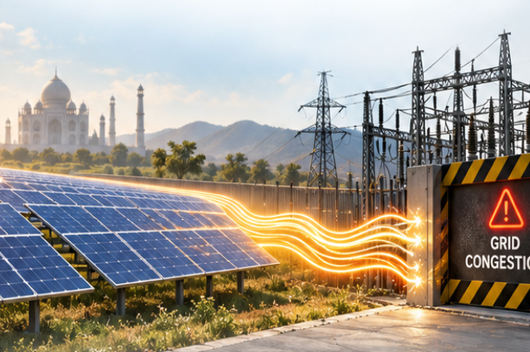
India is facing a thought-provoking paradox in its energy transition: while electricity demand continues to grow rapidly, the country has simultaneously been forced to curtail a portion of its potential solar power generation.
According to an Associated Press report, citing data from the Government of India and research by Ember, nearly 11 TWh of solar generation was curtailed over a 15-month period. According to the report’s estimates, this volume of electricity could have supplied power to approximately 10 million households.
The issue is not a lack of sunlight or generation capacity. Rather, the challenge lies between the power plant and the end consumer: transmission networks, energy storage infrastructure, and overall power-system flexibility have not expanded at the same pace as solar generation capacity.
Why Would a Country with Strong Electricity Demand Curtail Solar Power?
The answer lies in the mismatch between production and consumption patterns.
Solar generation typically peaks during midday, while peak electricity demand does not necessarily follow the same pattern. In many power systems, demand remains elevated into the evening, even as solar output declines.
When transmission capacity is insufficient during periods of high solar generation, energy storage is limited, and thermal power plants cannot reduce output quickly enough, grid operators may be forced to curtail renewable generation.
In India, the concentration of solar capacity in states such as Gujarat and Rajasthan has placed additional pressure on transmission corridors. According to the Associated Press, these two states account for nearly half of the country’s solar generation capacity.
When Solar Plants Are Built Faster Than Transmission Lines
One of the most important lessons from India’s experience is the difference in development timelines between generation assets and grid infrastructure.
A solar or wind farm can often be developed within a relatively short period, whereas transmission lines, substations, permitting processes, and grid expansion projects typically require significantly more time.
This imbalance highlights one of the central challenges of the energy transition: adding new generation capacity does not automatically guarantee the ability to deliver that electricity to consumers. Power plants, transmission networks, substations, storage systems, demand-side management, and flexible resources must be developed as components of a single integrated system.
Another Challenge: Thermal Power Plants Cannot Simply Step Aside
A further complication stems from the dominant role of coal-fired power generation in India’s electricity mix.
Even as renewable capacity expands rapidly, coal remains the backbone of India’s power sector. Large thermal power plants cannot be switched on and off like a light switch. Rapid load reductions can affect efficiency, operating costs, and technical stability.
As a result, when solar generation surges during the afternoon, reducing output from coal-fired units quickly enough can be difficult. Under such circumstances, the system may simultaneously have access to low-cost solar electricity while still needing to keep part of its thermal fleet online.
This is where power-system flexibility becomes critically important.
The Storage Gap: From a Few Gigawatts Today to Tens of Gigawatts Tomorrow
Energy storage represents one of the most effective solutions to this challenge.
Battery systems can absorb surplus solar electricity during midday and discharge it several hours later, when solar production declines and evening demand rises.
According to the Associated Press, India had approximately 3 GW of battery storage capacity by mid-2026. In contrast, projections from the Central Electricity Authority (CEA) indicate that integrating large-scale solar and wind generation by 2031–32 will require approximately 73.93 GW / 411.4 GWh of energy storage capacity.
This requirement includes approximately 47.24 GW of Battery Energy Storage Systems (BESS) and 26.69 GW of pumped-storage capacity. The Indian government has also recommended that future solar tenders include minimum levels of co-located storage.
India Is Building One of the World’s Largest Clean-Energy Systems
The significance of these challenges becomes clearer when viewed in the context of India’s renewable-energy expansion.
By mid-2026, the country’s clean-energy capacity had reached approximately 331.7 GW, surpassing fossil-fuel capacity, estimated at around 302 GW, for the first time.
According to Reuters, citing Ember and Global Energy Monitor, India’s solar capacity increased from approximately 0.07 GW in 2010 to around 211 GW by mid-2026. The country’s official target is to achieve 500 GW of non-fossil-fuel capacity by 2030.
From this perspective, the curtailment of 11 TWh of solar generation should not be viewed as a failure of India’s solar expansion. Rather, it signals the country’s transition into the next phase of the energy transition—one in which the primary challenge is integrating large volumes of variable renewable energy into the grid.
The Key Lesson: Energy Transition Is Not Just About Generation
India’s experience offers an important lesson for all countries rapidly expanding renewable energy.
If solar capacity grows faster than transmission infrastructure, storage systems, electricity markets, demand-response mechanisms, and the flexibility of existing generation assets, a portion of the investment made in renewable energy will be unable to deliver its full value to the power system.
Under such conditions, the issue is no longer a shortage of generation capacity—it is a shortage of the system’s ability to absorb that generation.
Building a 1,000-MW solar power plant creates its full value only when the grid can transmit its electricity, storage systems can preserve surplus energy, and market structures can shift energy to the periods when it is most valuable.
Conclusion
The story of India’s 11 TWh of curtailed solar electricity is not a story of “wasted sunshine.” It is a story of a fundamental transformation in the power sector.
As the share of variable renewable resources such as solar and wind continues to grow, economic value increasingly shifts from simply building generation capacity to managing that capacity effectively.
Additional transmission infrastructure, smarter grids, large-scale energy storage, flexible generation resources, and advanced demand management are becoming just as important to the energy transition as solar panels and wind turbines themselves.
India’s experience delivers a clear message: the future of clean energy cannot be measured solely in megawatts of installed capacity; it must also be measured by how much of that capacity the grid can actually accommodate and utilize.