
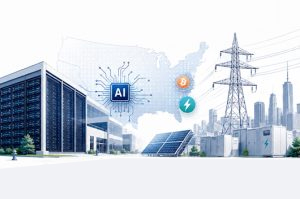
The rapid expansion of artificial intelligence is creating a shift that received far less attention only a few years ago: competition for computing power is increasingly becoming competition for electricity.
The growth of large-scale data centers, cloud-computing infrastructure, and the processing facilities required to train and operate AI models is introducing a new source of demand to power systems. The impact of this trend is now becoming visible in official U.S. energy forecasts.
In its latest Short-Term Energy Outlook (STEO), the U.S. Energy Information Administration (EIA) projects that electricity consumption will reach new record highs in both 2026 and 2027, following a record-setting year in 2025. According to the EIA, growing demand from data centers is one of the key drivers behind this trend.
Three Consecutive Records in Electricity Consumption
The EIA forecasts that U.S. electricity consumption will increase from 4,195 billion kWh in 2025 to 4,268 billion kWh in 2026, and further to 4,391 billion kWh in 2027.
This means that within just two years, annual electricity demand will grow by approximately 196 billion kWh.
Importantly, this increase is not simply the result of population growth or traditional economic activity. The expansion of AI-related data centers, cloud-computing infrastructure, selected cryptocurrency operations, and the broader electrification of heating and transportation are fundamentally changing the structure of electricity demand in the United States.
Data Centers: From Technology Facilities to Energy Infrastructure
Modern data centers perform enormous volumes of computing operations around the clock.
The high-performance processors used to train and run AI models consume substantial amounts of electricity. In addition, cooling systems, storage infrastructure, networking equipment, and backup power systems contribute significantly to overall energy consumption.
As a result, the location of a large data center is no longer determined solely by access to land, connectivity, or skilled labor. Reliable electricity supply and sufficient grid capacity have become critical factors in investment decisions.
The importance of this issue is particularly evident in Texas. After the announcement of a temporary slowdown in new data-center development within the state, the EIA reduced its forecast for Texas electricity demand growth in 2027 from 14% to 6%. This serves as a clear indication that data-center projects can now materially influence electricity-demand projections for entire states.
Where Will the Electricity for AI Come From?
Rising electricity demand does not necessarily imply a return to fossil fuels, but power systems will require a diverse mix of resources to meet new loads.
According to the EIA, during the first half of 2026, U.S. electricity generation from solar energy increased by 21%, hydropower by 9%, and wind energy by 6% compared with the same period in the previous year.
At the same time, electricity generation from natural-gas-fired power plants also increased and is expected to grow further in 2027, while coal-fired generation continues its long-term decline.
This energy mix highlights an important reality about the future power system: rapid deployment of renewable energy is essential for meeting new demand, but reliable generation capacity, transmission infrastructure, energy storage, and flexible resources must also expand in parallel.
Artificial Intelligence Has Become an Infrastructure Challenge
What is happening in the United States is not merely a local issue.
Across many major economies, the growth of artificial intelligence is bringing topics such as grid capacity, power supply for data centers, new generation projects, energy storage, and long-term power purchase agreements back to the center of corporate decision-making.
Even companies whose core business has little direct connection to the energy sector are increasingly required to make strategic decisions regarding electricity supply, grid reliability, energy pricing, and energy security.
This development is gradually blurring the boundary between the digital economy and the energy economy.
An Important Paradox
Artificial intelligence presents a unique paradox.
On one hand, AI can help optimize power systems by forecasting demand, improving grid operations, enhancing power-plant performance, reducing energy consumption, and increasing overall efficiency.
On the other hand, the physical infrastructure required to support AI has itself become a large and rapidly growing consumer of energy.
Consequently, the key question for the future is not only how powerful artificial intelligence will become, but also how power systems can provide the electricity required for this growth with acceptable costs, high reliability, and lower carbon emissions.
Conclusion
The EIA’s forecast of new records in U.S. electricity consumption during 2026 and 2027 reflects a much broader transformation: energy infrastructure is increasingly becoming one of the defining constraints on the growth of the digital economy.
In a future shaped by expanding data centers, advanced manufacturing, electric vehicles, and broader electrification, generation capacity alone will not be sufficient. Grid expansion, energy storage, demand-side management, and secure, reliable energy supply will become essential components of technological competitiveness and economic growth.